Tuesday, May 29, 2012

How Russia Has Changed (For Me)

Russia is complicated. You can ask any number of experts what Russia is and you will get an infinite number of contradictory answers. I'm honestly trying to think of any other subjects as intangible and difficult to describe as Russia, and I'm coming up blank. Religion generally has set texts that, while open to wildly different interpretation, are nonetheless written on paper. Physics has a huge number of different areas of study, but one concrete scientific method. But Russia, Russia doesn't have a book. In fact, it has one of the widest ranges of literature of any country in history. Russia is huge, but there is not one method of interpretation. I've been told that Russia is: art, class warfare, peasantry, autocracy, spiritual, cruel, nature, contradiction. The only concensus that I have ever found is that everyone agrees that Russia is complicated.
There are two quotes that I learned in Russian 101 that define this sentiment. Pushkin wrote that one cannot understand Russia with their mind, they can only believe. Someone else said that one can know Russia in either 30 days or 30 years. In 30 days, you get a vague idea of the country, but after that, surprises begin to throw wrenches in the theory. It takes 30 years to get to the point where each tiny detail finds its place in one's conception of Russia.
So now I've spend an entire year of my life in Russia. The last 9 months have been completely different than the 3 months I lived in Moscow. When I lived in Moscow, Russia was art, clubs, business, politics, bustling. I was a tiny speck in a city of 12 million. I was awed by the buildings, wealth, and metro. Moscow was Soviet and the Oil power crammed into one city.
Ulan-Ude is the opposite. Ulan-Ude is culture, nature, quiet, poverty, Baikal. Russia is beautiful, wild, largely untouched nature. I see bear tracks in the forest. I climb rock formations similar to those in Utah. I swim in 25% of the world's fresh water. I see shamans. I visit Buddhist monasteries. I eat omul. I see stars.  I wander the steppe.
Moscow's grandeur now seems like such a waste to me. What is more awe inspiring than looking at Lake Baikal or traveling through taiga, forest, steppe, and mountains, all in just one tiny part of Russia?
I went camping last week. We climbed to the top of a rocky mountain and spent the night. The next morning, the entire mountaintop was enveloped in clouds. It was only possible to see 20 or so feet ahead. After we set out, we came across our tracks. Assuming they were from the previous day's hike, we followed them. Shortly afterward, we realized that there were twice as many tracks. We were going in circles in the fog. It was incredibly difficult to ascertain whether we had seen a certain tree that day, or the day before, or ever. We finally resorted to just following the compass and hoping for the best.
Understanding Russia is like wandering in the fog. The entire scope of the country is so large that fitting it all into your head is impossible. Even things that you've seen before change as you learn more and interpret them differently.
Eventually the fog lifted, but honestly, our hike was much less interesting after that. Hiking in the fog, crossing rivers, and seeing bear tracks had an incredibly dream-like, mystical quality. Once the sun was out, it was just a routine hike. So, here's to the fog that is Russia. May it ever remain a mystery.

Monday, April 16, 2012

Munku-Sardyk


"Hi! I'm Brian and I'm researching cultural and historical tourism in Buryatia." "Do you want us to publish a paper for you and take you to the highest mountain in Buryatia?" I had just walked into the office of the Department of Sport and Tourism at Buryat State University. This may have been the best introduction I've ever had. It turns out that the Department was planning an International Tourism Conference and having an American makes it a lot more international than just Russians and Mongolians. I agreed immediately and set out writing a paper worthy of being published. Of course, what I was most looking forward to was going to the tallest mountain in Buryatia. After spending far too much money and time finding mountain climbing equipment, I was ready to go.
The Conference consisted of a day of lectures and discussions and then two groups going to Munku-Sardyk. Munku-Sardyk is in the Sayan Mountains, right on the border between Russia and Mongolia, so one group climbed up from Mongolia, the other from Russia. At first I had planned on going to climb up the Mongolian side, but only Russians and Mongolians are allowed that close to the border, so I had to settle for the more difficult climb from Russia (which was also legally tricky and another story entirely). After sharing some of my ideas on cultural tourism and the current direction of tourism in Buryatia, and the necessary dinner with vodka with all of the VIPs, I went home and packed my backpack.
We were supposed to leave at 8 in the morning. At 8, 3 people had shown up. We left at 9. We spend about 9 hours on the road on day one. We drive all the way down Baikal and into the Tunkinsky region, which is where the Sayan Mountains are located. We spent the first night in a children's camp in a small village called Kyren. The village was located picturesquely against a backdrop of mountains. The building we were in consisted of some offices and a gym. The gym was unheated. The students slept there. We spent the first night starting to get to know each other. In particular, I spent a good amount of time speaking with Arkady, a scholar from Irkutsk. Arkady started off as a physicist and mathematician, but after spending years with radio telescopes in the mountains we were in, he became interested in ethnography and wrote a book about the ethnic groups of the Sayan Mountains. He was wonderfully intelligent and pessimistic and looked exactly like Larry David.
The next morning, we set out for the mountain. We drove another few hours until we got to Mondy, the last town before Mongolia. After waiting at the border checkpoint, we drove to a river called the White Irkut. After a short lunch, we hiked up the frozen river. This was my first experience with climbing spikes, which you attach to your shoes. It took some getting used to, but I made it to camp. Of course, I had one of the largest blisters ever by that point. Camp was located a few km up the river and had a shamanist shrine welcoming us. Although we went relatively early in the year, there were multiple groups of climbers already at the campsite, so I went with one of the teachers and a Mongolian teacher to meet some of the other campers. There was a group from the Ministry of Economics, a group of rescuers, and some other government groups. Most of the local climbers had never seen an American before. I met a very interesting man who had never received an education but read and read and read. We talked about Russian-American politics for quite some time. He was the first Soyot I've met, an ethnic group in the Sayan Mountains.
That night, after dinner, I sat around the fire with the students. It started snowing, slowly at first, but then much harder. I decided to go to bed. I was in a tent with the leader of our group and a woman from Irkutsk. After talking some, we went to sleep. I didn't sleep at all. There was a huge root under my sleeping bag and it was quite cold. I hate sleeping with my face covered, so my body was warm but my face was freezing. After a seemingly endless night, morning finally came.
On our first day, a group of the most experienced climbers went to Munku. I went with the second group of less experienced climbers to, as our leader called it, practice. So, we continued hiking up the river, this time up some rapids and waterfalls. We hiked for about an hour and a half before we got to a steep waterfall. After ascending the waterfall, we took a break for snacks. The blister on my ankle was killing me by this point. We then removed the spikes from our shoes and started climbing. We probably climbed for an hour before we took our next break. I was honestly expecting to be turning around any second. We had already hiked a couple km up the river, plus climbed a pretty much vertical km. I asked where we were headed. One of the leaders pointed to a nearby mountain. "How tall is that?" "Oh, about 3 km." "And Munku-Sardyk is..." "3.5 km." "I see." My heart plummeted. I could barely walk by this point. I had changed how I walk due to the blister, and now my hamstrings were complaining. We continued climbing. By the time we had ascended about 2 km, the temperature dropped and the wind picked up. Taking breaks now meant judging between how much rest was necessary and how long you could stand still before your hands started freezing. We saw a group of mountain goats and marveled (for me, it was closer to envy) at their ease at climbing the mountain. After a few final pushes, we reached the peak.
The view was unbelievable. Munku-Sardyk was directly in front of us, and the Mongolian steppe stretched beyond it. Unfortunately, we got caught up in the marvel and rested too long at the top. My gloves, which were wet from sweat and snow, froze solid. Literally. My hands, which I believe have gotten fairly used to cold after a Siberian winter, began to hurt very badly. I'm no frost-bite expert (I should be after a winter here), but I think that's one of the warning signs. The 5 feet of snow covering the top of the mountain and disguising the edges of the cliffs that dropped off to either side did little to keep my hands warm. Between slipping and balancing myself, my hands got, if anything, even wetter. Fortunately, one of my friends had an extra pair of gloves. After circling the top of the mountain, we began our descent. The first km was about a 70 degree descent. The second two kms were a blast. If we had had skis, it would have been one of the most fun ski slopes I've ever seen. We all just slid down on our butts. Again, I got soaked.
We made it back to camp just as it was getting dark. The hike that I expected to be a short training exercise lasted all day and consisted of a three km climb.
This was when I began to consider the climb the next day. My gloves, shoes, and pants were soaked. I only had one pair of each. I had the worst blister of my life on my right foot and I could barely move it after limping all day. I decided to wait until the morning and see.
When morning came, my leg felt even worse. My pants had frozen solid and I could only get my feet through them after whacking them on some rocks. I decided to sit it out. There were actually a good number of us who didn't go, either due to a lack of proper equipment or the difficulty of the hike the first day (this is actually an issue that I've talked over with other guides on Munku. Many believe that it's just better to do Munku right off the bat). We saw the group off and then began cooking. And cooking and cooking. And eating. We also picked up some trash, which ended up being fairly entertaining as me and some of the other male students reacted in horror to the mass of sanitary napkins we uncovered. I let my wet clothes continue to dry. Some of the other groups of campers who were leaving brought their left-over food to us. We attacked the food with gusto and swore a vow to not tell the climbers that we had real meat.
By 7:00, we began to prepare dinner for the returning hikers. We waited, and waited, and waited. When it was dark, around 9, we called the rescuers. Then the wind picked up. I was freezing, and we were in a wooded campground. At ten, they sent a group up. They didn't find our group until midnight, and they didn't all get back until 1. When the call that they were close came in on the short-wave, one of the students ran up the waterfall to meet them. His headlamp bobbed up and down, reflecting eerily off the blue ice. Then, one light appeared to greet him. And another. Soon, about a half-dozen lights were descending the frozen waterfall. The student that ran out to greet them was soon just a black figure on a background of glowing blue ice and bobbing headlamps.
As the hikers came to camp, the story came out. Apparently, one of the climbers had fallen about 200 meters. He was fine, but they moved much more slowly after that scare. I guess in the end, my decision to not climb was actually a good one. I would not have handled descending in the dark very well. As we got ready for bed, one of my tentmates pulled out a bottle of Balsam. I had never heard of it before, but it is an alcoholic herbal drink with ingredients such as calamus marsh, saxifrage, valerian, coriander, calendula, paw juniper, peppermint, chamomile, thyme, pine needles, rose hips, red ash, and lemon, vanilla, orange, and anise oils. This brand was apparently the preference of the Dalai Lama. It is awesome.
The next day, we slept in and then left to go back to the road around 11. The hike down the frozen river was fairly uneventful except for running into some hikers heading to camp, who were shocked to encounter an American and three Mongolians without any Russians (the others were either way in front or way behind us). When we got to the cafe on the road, I ate pelmeni and plov with relish and thoroughly enjoyed a beer.
Our journey home was remarkable to me due to the gradual increase in "civilization." We drove about 3 hours to get to a town called Zhemchuzhina. We met a Buryat family and ate dinner, which consisted of a very delicious goat stew. We were to stay in a basically empty house. One side was rather chilly and had few beds, the other side was closer to the stove. Guess which side I stayed in with the teachers? The teachers had an itch to get drunk, but I said I didn't want to drink vodka, so I went to town with two of them. A friend of the owner of the house offered to drive us. He was also going to pick up friends of one of the students in our group. He dropped us off at the only store in town, which was to close at 9, but at 8:45 was already closed. They had a walk-up window, however, so we made our orders there. As we stood outside the store, cars began to pull up to the store and unload 4-5 men. Occasionally, one of these men would walk up to the window and the woman inside would give him a bottle of vodka. No cash was transferred. Soon, there was a veritable crowd hanging outside the store. The men I was with didn't seem to worried, so I just kept my mouth shut and waited for our driver to get back.
When he got back, we climbed into the car and the driver started telling us about this town. The Tunkinsky Region, which is where this town is located, is the most criminal area of Buryatia, at least according to the media. The driver didn't buy it, he finds it to be quite quiet. Tourism is huge in the town. It has hot springs and is close to the mountains. We were the only people in town at the time, but in summer, there isn't a place to park in the entire town. However, tourism isn't exactly welcomed in town. The thing is, there is only one Buryat place in the entire town. Everything else is owned and run by Irkutsk, so the locals see almost no income from tourism. The driver also talked about the local government. The director of the region, who had been a member of the Komsomol, had done almost nothing to develop the region. For example, the road from the main road to the village is in terrible condition, but it costs 30 million rubles and tourism only brings 3 million rubles in to the budget in one year (if I heard correctly, this is probably incorrect). So they haven't built it. We asked why he had done so little to develop the region, and he answered that he had been too busy buying new houses.
That night, I spent the first half hanging out with the teachers. They said toasts and we were visited by the owner of the place. We asked him what his opinion of tourism was, and again, he declined to respond. In all of my travels in Buryatia, this was the first time I've seen such a negative response to tourism. This validates the research I've been reading which claims that for tourism to be successful, it has to be developed by the local community. When outsiders come in and develop, local interests and culture are often ignored. After getting sufficiently drunk, the teachers told me to go and hang out with the students. We sang songs around the campfire while they got drunk. Sometimes, I don't understand how people in this country function.
The next day, we set off back to Ulan-Ude. This was the most frustrating bus ride ever. The bus we were on was terrible and could only go up minor slopes at about 15 mph. We were on the road for 12 hours. And most of the group was hungover.
I learned a great deal on this trip. I truly got to see another side of tourism in Buryatia. Not only did I see the Tunkinsky Region and its disappointment with tourism, I got to experience tourism with a focus on sport, not on culture. On the road, we still stopped at every Buddhist and Shamanist shrine, not because we were tourist, but because it is a part of the daily lives of locals. This is a hugely important part for any successful tourism, cultural or not. Another part of my experience was dealing with more typical Russian tour guides. My travels with the Tour Agency of the Republic of Buryatia have always been extremely professional and enjoyable to such an extent that I didn't realize why they were so successful. This trip opened my eyes to some of the things I expect from a guide. Most of my problems rotated around a lack of a clear schedule. When will I eat. How far will we climb today. I also ended up buying a lot of climbing gear that I didn't actually end up using. Another major issue with nearly every experience I've had traveling is one of the guides getting belligerently drunk. I understand Russian culture, but some control is necessary around foreigners. I went to college, I have dealt with drunk people and imbibed my own fair share. But I, as a guest, should not feel uncomfortable due to one of the tour guides having too much to drink. Fortunately, a frequent problem that I have not yet experienced is littering. All of the guides I have met have been extremely eco-conscious, which is a success for the ecotourism campaign over recent years. And the above problems are known and several organizations are beginning to offer seminars to teach guides business etiquette. In fact, the only truly worrisome trend is the lack of local involvement in tourism in Zhemchuzhina. I believe this may be more closely related to governance in the region than to anything else. Corruption is a weed to business success in this country, and unless it is combated at every level, economic success will be stifled. Tourism has been and can continue to be successful in Buryatia. This trip was a chance to see one of the more beautiful locations in the Republic as well as some warning signs.

Saturday, February 25, 2012

Sagaalgan

Sagaan haraar! Sagaalganaar! These words echoed throughout Buryatia on February 22, the day that marks Sagaalgan, Buddhist New Year and the first day of White Month. Sagaalgan may be the most important Buryat holiday and marks the transition from winter to spring. As Sagaalgan approached, I began to wonder how I would be taking part in the celebrations, until I received a call from my research advisor. "Brian, we are bringing Japanese Santa Claus to Buryatia for Sagaalgan. Do you want to travel around on the bus with him?" "Uh, sure..." "Also, you're going to judge buuzy with me." "Sweet."
So, I showed up on Soviet Square on Sagaalgan to judge buuzy. There was a huge stage set up in the center of the square, where people were singing traditional songs and dancing. As I was waiting, the mayor of Ulan-Ude spoke, and then the four fairy-tale heroes came onstage. These were to be my travel companions, so I'll give you some background info.
Our first hero is Sagaan Ubgen, Bely Starets, or White Old Man. This character is associated with Buddhism and makes appearances every year around Sagaalgan. The man who played Sagaan Ubgen was a dignified old man who was in the Red Army in the 1960s and was involved in theater for much of his life.
Our second hero the Evenk Matushka Zima, or Mother Winter, Tugeni Enyoken. The Evenk are a minority population that mostly live to the north of Baikal. Unfortunately, I didn't have much opportunity to speak much with Mother Winter, but I know that she is a recent graduate from Irkutsk.
Our next hero is Sohk-Ireya, Old Man Frost from Tuva. The man who played Sohk-Ireya is Edward Ondar, a famous actor from Tuva as well as an excellent throat singer.
Finally, the most surreal hero was Yamamoto, the Japanese Santa Claus. This man, whose full name is Paradise Yamamoto, first worked as an automobile designer for Subaru. After he got tired of that (or something), he became interested in Mambonsai art and music. A few years ago, he became the first Asian to become an accredited Santa Claus. It was an absolute pleasure to speak with this man.
So, as I mentioned, I was to judge buuzy (traditional Buryat meat dumplings). While this experience was fully delicious, it was not super interesting, so I'll just note that I gave the highest marks of anyone, which clearly reflects on my lack of buuzy expertise.
After the judging, I went to the Ethnographic Museum with the fairy-tale heroes. The Ethnographic Museum was packed with children waiting to see Santa Claus and the other Christmas characters. I was also surprised to see many of my fellow riders from the hippodrome, who were there to drive horse-drawn sleighs for the heroes. The ethnographic museum consists of several old homes that were relocated due to the increase in Baikal's water level after the dam installed for Irkutsk Energy. Each of these homes represented a different culture of the region. There were representative contingents of each culture to meet the heroes and offer each a small meal. These included Old Believers, Eastern Buryats, Western Buryats, and Evenks. This experience represented much of what I believe makes Buryatia a wonderful place: all major cultures and peoples were represented without any attempts to show one culture more than another.
The next morning, we set out for Baikal. We made our first stop in a Monastery in Troitskoe, a village in the Pribaikal Region of Buryatia. They are currently rebuilding the monastery, as it was used as a mental hospital in the Soviet era. One of the monks gave us a tour around the place. We then went to the shore of Baikal in the Kabansk region. Our first stop was a shamanist holy site up on a hill overlooking Baikal, Usan-Lobson. There, we danced in a circle around an evergreen tree. Finally, we got to the hotel in Enkheluk, which is one of the most well-known tourist towns in Buryatia.
In Enkheluk, the heroes participated in an event called Sagaalgan on Baikal. There were more than 60 kids there to play games and see various cultural performance. Unfortunately for me, this meant standing outside in deep snow for several hours, something my shoes were not exactly made to handle. After hearing my distress, the director of tourism of the Kabansk region reached into her purse, pulled out two sanitary napkins, and stuck them to the soles of my shoes. It worked. Apparently, Russian hunters and ice-fishers use this technique quite often.
After the games, the fairy tale heroes went ice fishing for about five minutes, but then they got too cold and decided to move on. This is when me and some of the other tour operators got separated from the group. We dropped by a Ministry of Extreme Events camp on Baikal and had some tea while we tried to regroup. After we left and were walking down the road, I saw something that I will never forget. At an intersection about 300-400 meters in front of us, a four-wheeler wizzed by. This first ATV caught my attention. A few seconds later, Santa Clause went flew by. Then Father Frost from Tuva. It was too surreal.
As we caught up with the other tour operators, we began to go on a tour of various hotels in the town. The first we went to was a hunter's cabin that one man had made entirely by himself. It was completely awesome. Then, we went to a hotel called Sakura (the owner went to Japan once), which was nice, reasonably priced, and they were building a nicely sized pool. The next hotel was the first hotel I've seen in Buryatia that was absolutely as nice as a brand-new Marriot, or something else of that calliber. It was filled with big-screen LCD TVs, tasteful decor, and they even had a Wii in the lounge. But the prices were ridiculous. The owner spent a nearly uncomfortable amount of time drooling over me, the American. As we left, one of the women who owned a different local hotel that I hadn't gotten to see, was quite let down. She was worried that the competition of such a nice hotel would make it difficult for her to do business. She asked me to come by and check out her hotel and give her advice. Which I did gladly, as she was an extremely friendly woman. I really liked her place and told her to call it a Bed and Breakfast in English. And now I'll shamelessly advertise for her: http://na-baikale.ru/ If you want to go to Baikal, stay with her. If you tell her you know me, she'll probably be even nicer than she already is.
That evening, we ate dinner at the hotel and I heard some of the most wonderful toasts that I've ever heard. But that's typical of life here in Buryatia, especially when the subject is Baikal.
The next morning, we got up early and went to a children's home. Again, we saw many different cultural presentations and the heroes got to interact with several children, which was really cute. When we got back to Ulan-Ude, I was very disappointed to say goodbye to the heroes and tour operators. Of course, several of us exchanged contact info, but such a magical few days may never repeat itself. Although, in Buryatia, you never know what can happen.

Sunday, February 12, 2012

Moscow-Vladivostok

After my time in Kazan, I flew to Moscow, where all of the Fulbrighters were gathering to have our final orientation. It's actually quite disappointing that this will be our last time all together as a group. For those of you Fulbrighters that might stumble upon this post, thanks a lot for your presentations in Moscow. You helped me get mentally prepared to return to Ulan-Ude and really get some work done. Other than the orientation, I had a wonderful time in Moscow going clubbing with the Fulbrighters (and having adventures at Subway) and eating Georgian food.
I then flew to Vladivostok with two other Fulbrighters. There were several remarkable parts of the travel experience itself. First off, I've never flown out of Moscow Vnukovo airport. I was assuming that it just barely be a step up from the Kazan or Irkutsk airports, but it was actually the nicest airport I've been in in Russia. Completely new, huge, and without the insane crowds of Domodedovo. Secondly, I take great efforts to avoid flying on Russian planes, especially Tupolev planes. So, when booking this flight, I made sure to book on the Airbus plane. Unfortunately, as we approached our plane, it was the Tupolev version of the Boeing 767/Airbus A320. "Ok," I told myself at a slightly panicked pace of thought, "these planes fly all the time without too many crashes." After getting on the plane, all seemed fine. It looked almost exactly like the interior of an A320. "I'll survive this." My chair was the most uncomfortable chair that I have ever flown in. "No big deal, it's just a chair. At least they cut costs here and not somewhere else, right? Right?" After deicing and other pre-takeoff activities, we were at the end of the runway (sidenote, this is the first flight I've ever been on with no English). As we began speeding up, all seemed fine. Regular acceleration, not too bumpy. But then we left the ground. My ears immediately began popping. Weightlessness. "We're falling out of the sky. I'm going to die." The only way I can really describe the next 10 minutes of the flight is "hurtling through the air." I don't know how Boeing or Airbus does it, but my ears pop a little and everything feels under control. This was the first time I could actually tell that I was speeding through midair at upwards of 500 miles an hour. And then we reached cruising altitude (which was much lower than I've seen before). And then it was the smoothest 9 hour flight that I've ever been on. Landing was pretty uneventful as well (except I've never been in a ruder crowd at a baggage claim.)
We slept almost all day thanks to jetlag (Vladivostok is 8 hours ahead of Moscow). When we finally made it out, we went to the central square, which contains the biggest middle finger to the West (in this case, East) that I've ever scene. For those of you unfamiliar with the history of the Russian Civil War, after Russia left World War I and the Bolsheviks claimed power, the territory of Russia was embroiled in one of the bloodiest conflicts in world history. The main participants were the Red Army, the Whites (monarchists and democrats), and the Allied Intervention (Japan, USA, UK, etc.). Vladivostok was occupied by Japan. The occupation of Vladivostok by the Red Army in 1922 is considered by most historians to be the end of the Russian Civil War. The main square has a large statue facing East with text honoring the partisan forces who defended the city from intruders.
That night, I had the best sushi I've ever had. We then spent much of the night getting to know the other guests at the hostel. There was another girl from Ulan-Ude and several Koreans. There's a ferry that runs from South Korea to Vladivostok, so Vladivostok is a popular tourist destination for Asian tourists.
The next day, we took the funicular to the top of the city. A funicular is a small train that only goes up a hill. It cost about 25 cents. It took us to the top of the city. From there, it was possibile to see much of Golden Horn Bay and the Golden Horn Bridge, one of two cable-stayed bridges being built in Vladivostok (the other one will be the largest in the world).
We then descended down to the shoreline, where we found an old Soviet submarine. This sub was the most successful Soviet sub during World War II, having sunk 10 Nazi subs. You could wander around inside and see much of the original interior. I took full advantage of the photo opportunities.
That night, we got on the Trans-Siberian to head home, to Ulan-Ude. 3 days on the train is difficult to quantify. While on the train, it feels like 3 days. However, once you step off, you can't believe that three days have just passed. Most of the time on the train consisted of sleeping, playing Euchre, and watching Game of Thrones. I did venture to the restaurant car once, where I was befriended by a group of typical train-traveling Russian males and obliged to have some beers. I also managed to buy a meal and a computer charge for just one dollar (the men and the waitress were astounded by my American money). I felt guilty, but I did try to convince them to take more, and they did ask to see it in the first place!
So, that's my journey, summarized for the interwebs. Now, life is back to normal, perhaps even more so than 2 months ago. I have deadlines now, which will hopefully help me keep on task. So, if I don't post again for awhile, you understand why.

Tuesday, February 7, 2012

Moscow-Kazan

The last month I've had has been filled with some of the most blog-worthy moments of my time in Russia, but life on the road isn't conducive to blogging (at least in Russia, without Internet access). I recall thinking many time, oh I can't wait to blog about this, only to have that moment replaced by a new experience the next day. All I had along with me to record my trip was my camera. So, hopefully with the help of some photos, I'll be able to piece together some of my more interesting moments traveling through this unfathomably large country.
When I last posted, I was sitting in a hostel in Moscow, having just flown back to this country that I will be calling for another 5 months. Upon finishing that blog post, I embarked on one of my first major adventures of my Trans-Siberian travels. I convinced one of my Moscow friends with a car to drive me, another girl from Moscow, and another visiting friend from the States out to Sergiev Posad, the site of arguably the holiest monastery in all of Russian orthodox, the Trinity Lavra. The Trinity Lavra was founded by St. Sergius of Radonezh, one of the most venerated saints in orthodox history and the subject of one of my favorite paintings by Nesterov, and still contains his relics. The day we went to the monastery happened to be Russian Christmas Eve, so it was packed with pilgrims from all over Russia. We stood in line outside of the Trinity Cathedral (which contains the relics) for nearly an hour. Upon entering, it still took us nearly an hour to circle around the icons and get to the relics. While observing how people would light candles in front of the relics, cross themselves, and bow (because I soon would have to copy what I had seen as well as I could), I watched a man stumble up the altar. He stopped in front of the relics and managed to cross himself once before collapsing into a wailing, sobbing heap. A man who accompanied him attempted to get him to his feet, but to no avail. The main continued sobbing and clawing at the base of the gold-covered container that held St. Sergius' relics. After a few more minutes, several monks rushed in and carried the man away with extremely annoyed expressions on their faces. My two Russian Orthodox friends said that he was likely just too weak from the fasting that pious Orthodox believers often do before Christmas. My own candle lighting was much less attention-grabbing. I awkwardly crossed myself, bowed, and then waited while woman who had just cut in front me lit upwards of 10 candles.
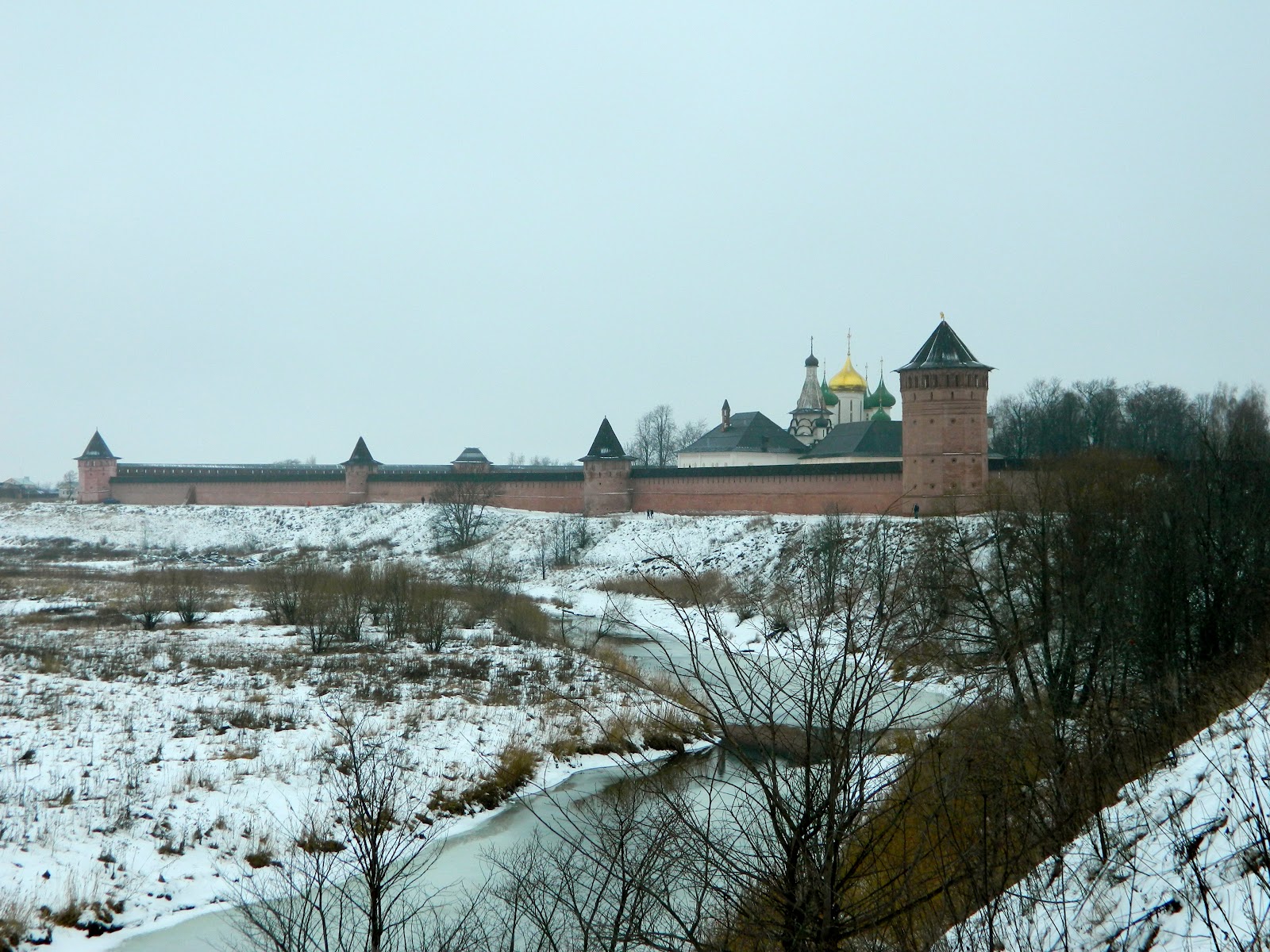
Fast forward a few days. After my day wandering around Vladimir (which was completely non-eventful), I met an British English teacher who was taking his holidays by traveling the Golden Ring. We found out that we were both planning on traveling to Suzdal the next morning, so we agreed to band together. We hopped on the bus to Suzdal and rode through the flat, snow-covered Russian countryside for about 45 minutes. Suzdal is one of the only towns in Russia that was not Sovietized. It is filled with churches, monasteries, and old wooden cottages. It takes about 30 minutes to walk from one edge of town to the other. Very little out of the ordinary occurred during my time in Suzdal. It was really just like hopping into a time machine and seeing what Russia was like 100 years ago. Suzdal was where I began wandering places that I probably shouldn't have wandered, but I got great pictures thanks to it. For example, I wandered along the side of the small cliff that the St. Euthymius Monastery is one and ended up next to the gates of a huge, brand-new mansion with absolutely no houses near it for several hundred meters. The view from the mansion looked something like this:

I don't know much about Russian property value, but I'm pretty sure someone payed at least 10 million dollars for a place like this. My practice of wandering where I shouldn't continued in Nizhny Novgorod.
Nizhny Novgorod is the 5th largest city in Russia. It was renamed to Gorky during the Soviet era, but its original name was returned after the fall of the Soviet Union. Nizhny Novgorod is geographical interesting due to its location on the T-Intersection of two rivers: the Volga (the Russian Mississippi) and the Oka. The Oka divides the city into what I call the old side and the Soviet side. The Volga divides the city into what I call "city" and "wasteland."

Tank firing across the Volga at "Wasteland"
One of the most frustrating things about public transportation in the city is that only two bridges connect Old City to Soviet City (one of these bridges was finished only a year or two ago, I'm so glad I came after that). The Nizhny Novgorod metro has "two" lines, but right now the two ends are connected. It currently only runs on the Soviet Side. Nearly everything that I wanted to see was on the Old side. I was informed that the first metro station in the Old City will open this November. That will make getting around the city much much easier.
One of my first major concerns during my entire trip was making sure that the Gorky Train Station was actually the Nizhny Novgorod-Moscow Train Station. When your ticket says one thing and Google Maps another, it makes things worrisome. Fortunately, this trip convinced me once and for all the Google Maps is not a fit travel companion in Russia. Upon my arrival, I had little to guide me to my hostel except for my utterly worthless map from Google. So, I hopped in a cab. Upon arrival at the hostel, the hostess annoyedly informed me that I should have reserved ahead. When I showed her my receipt and reservation number, she shut up. I was the only person in the hostel.
After unpacking, I asked which places I should check out. She could only come up with the Kremlin.

Well, duh. So, I made my way to the Kremlin, stopped in the museums (which were very bland) and picked up a few maps and tour booklets. The first museum to catch my eye was the Maxim Gorky house museum. For those of you who aren't familiar with Russian literature, Gorky was extremely influential in both the late pre-Soviet era and the early years of Socialist Realism (so much so that he is considered the father of Socialist Realism). So I headed to the museum. When I walked in, it was quickly obvious that I was one of the first non-child visitors in quite some time. The fact that I was a Russian-speaking American raised the level of excitement to an even higher notch. After first eyeing me with suspicion after I requested a Russian guidebook, the museum workers quickly warmed up to me, inviting me to enter roped off areas and telling me that I was marvelous and should marry their grand-daughters. The museum itself was fantastic, filled with Gorky's library and art collection. There was even a signed picture of Chekhov on Gorky's desk. I bought all of my Nizhny Novgorod souvenirs from the museum (I have a special spot in my heart after working at a Russian museum).
Upon leaving the museum, I decided that I wanted to see the main monastery before the sun went down. This proved to be more difficult than I expected, but once again resulted in me going to somewhere off the beaten path and great picture opportunities. According to the map, the monastery was on the cliff on the Oka River, so I walked over there. Upon my arrival at the cliff, I realized that there was no path down the cliff to the monastery, but ridiculously great views of the city.

My other favorite part of Nizhny Novgorod was the Chkalov Staircase. It is the largest staircase on the Volga River (what does that mean?) and was built in honor of World War II. According to one booklet I read (I have not managed to find other information confirming this), the architect was given a blank check by Stalin to build the monument. However, once it was built, Stalin decided that the architect had actually spent too much and sent him to the GULAG. At least the staircase is actually pretty sweet.

After 2 days, I hopped on the overnight train to Kazan, the capital of Tatarstan and the home to the most Fulbrights of any other city in Russia. After a non-eventful train ride, I arrived in Kazan. I spent most of the first day sleeping and relaxing after two weeks of constant awareness of where all of my belongings were. After that, I began exploring. Kazan is super wealthy. Tatarstan has a lot of oil, and that oil money goes towards building new buildings, renovating museums, ice hockey arenas, and more. Therefore, much of Kazan is absolutely beautiful. It also has a mosque in its Kremlin.

Kazan has the nicest grocery stores I've been in in Russia as well (just throwing that out there). I spent most of my time with the other Fulbrights, just seeing how they live. In terms of actual style of life and workload, they live very much like me. But in terms of social circles, the existence of other Fulbrights in close proximity is difficult to resist. While they all have Russian friends, they also see each other fairly regularly. It doesn't help that all Fulbright fellows are awesome by definition (at least in terms of how easily we all get along with each other). Kazan gave me a good opportunity to compare my experience with that of multiple other Fellows. My quality of life might be lower here. It might be way colder out here. But I have no temptations to hang out with other Americans because there really aren't any. It's an interesting little exchange that I was only superficially aware of when I chose Ulan-Ude, but my travels have made it much more visible.

Wednesday, January 4, 2012

Home for the Holidays


There's no place like home. I'm allowed to say that because I'm from Kansas (or is it the other way around?).  But it really is true. And it's not even just being back in your hometown, it's about being back in your own country. Where people grew up watching Sesame Street and The Rugrats. Where I can have a conversation with a customs official or store clerk and not have to worry about language or cultural faux pas. Where I can drive and know that 1st street is after 2nd street (except in DC). And especially where I know exactly where to go to find food.
That being said, I'd like to elaborate on the meaning of vacation. For me, vacation is still associated with summer and freedom from school. During the summer, I would relax at home, see friends, and swim way too much. When I got older, I began to work during vacation. On Wikipedia, vacation is pretty much defined as taking a trip somewhere. I was actually really surprised by how short the article is, considering how many various definitions of vacation I have floating around in my mind. So, disregarding everything Wikipedia has to say, which I know is heresy to this blog, I posit that vacation is merely an escape from the normal. For your average American family, that means taking a three hour drive and sitting in a hotel in a tourist trap. For school kids, it means time off of school. And for your average adventurer in Russia, it means going home.
I have to say that I by far prefer my vacation. Whenever you leave your comfort zone, a level of chaos enters the equation. Now, of course, this level of chaos stays very low in places like Branson or Breckenridge. But think of the number of Hollywood comedies about disaster vacations. Those comedies are so funny because we can always relate. Once you leave the comfort of home, Chaos gets stronger and stronger. Of course, there are comedies about coming home for the holidays as well, but don't those always end with the family getting closer?
When you live in Siberia, Chaos reigns supreme. The equivalent of a State Capital Building in Buryatia caught fire 2 days before I left. Think about that. Last winter, they wanted to put an ice skating rink on Soviet Square in the center of town. No one thought to hire an engineer to make sure the rink was flat. No one noticed that the water was gather along one edge of the rink until it was too late and the wooden gates broke, letting loose a flood of water that led to the entire center of the city being covered in several inches of ice. My friends who work in a kiosk on Soviet Square were entirely unable to open the door of their store. That's where I live.
The United States is ruled by institution and order. You may disagree, but often times our frustrations are the result of too much double-checking and oversight. I think our rules of the road are an excellent example of this. Our roads are well-constructed and orderly. Very few people run red lights. But people hate seeing cops because of speeding tickets. In Russia, when a cop pulls you over, they want a bribe. We in America hate getting caught. In Russia, there's very little you can even do about it. If you follow the rules in America, there's little that can happen to you. And our roads are not the nightmare that Russian ones are.
So coming home to familiarity and order led to some of the most relaxing two weeks of my life. I drove around. I lay around. I played Skyward Sword like there was no tomorrow. And I basked in the utter lack of concentration that speaking English requires.
But when I landed back in Moscow, my heart began to pound and I felt a rush of adrenaline. It was similar to the feeling that I would get before a really great 200 Free. I knew I was back in my element. I understood every word of Russian, I knew every bureaucratic procedure, I knew how to travel on the subway. While I was in the States, I spent most of my time playing a game. In Russia, getting from point A to point B is a lot like solving a puzzle in Zelda. You have to study the map, but when you get to a key intersection, you find that it's closed off. So you go through your bag of items and pull out the ones you need to get around this roadblock (Russian language, knowing when to wait or when to find another way, etc.). And when the puzzle is solved, it's way more satisfying that anything that could be found in a videogame (much like getting through Skyward Sword is way better than anything in any other videogame).
Being home was perhaps the best vacation I've ever taken. But living in Russia is the best step I've ever taken in real life. And realizing that yesterday may have been the best part of the vacation that I took.

Saturday, December 10, 2011

The Hambo Lama and Getting Sick

Several weeks ago, I was fortunate enough to have the opportunity to go to the Ivolginsky Datsan during a Buddhist holiday to see the body of Hambo Lama Itigilov. Itigilov is quickly becoming one of the most important religious attractions in Buryatia, and for good reason. The Hambo Lama died in 1927, after beginning a death meditation. Prior to his death, he had asked some of the other lamas to exume his body after several years. In 1955 and 1973, his body was unburied, and the lamas of the datsan shocked to find that the Hambo Lama was not subject to macroscopic decay. The lamas were unwilling to divulge the existence of the body to the Soviet authorities and the body was largely unknown until 2002, when his body was moved to the Ivolginsky Datsan. Now, his body is revealed once a month, on Buddhist holidays.
I went with several friends to the datsan. Upon our arrival, we took the rice that we had brought with and walked around the datsan, spinning the prayer wheels and sprinkling rice at each wheel. It was a pretty cold day and my hands went numb very quickly. When we arrived at the main temple, we removed our hats and scarves and entered. At first, I didn't even notice the body of the Hambo Lama. It wasn't until I began to move about the temple that I saw that the Lama was placed near the far wall in the center. He was sitting in what looked like a refridgerator with a clear door that was open. He was draped with cloths and ribbons and when you walked by, a lama would offer you a cloth for you to place your forehead on. It is said that if you make a wish, it will come true. I'm not exactly sure what I was expecting, but it certainly wasn't what I saw. The body certainly did not look like it had been dead for most of a century, but it was still fairly indistinguishable. The face was mostly just plain skin, it looked almost like peach playdough. However, it cannot be denied that the temple had a very profound sense of importance, majesty, and peace. I kept trying to ask myself if being a tourist there was sacrilege, and I honestly never felt like too much of an outsider. Religious tourism is such a tricky subject.
Other than my visit to the Ivolginsky Datsan, my life has been rather bland recently. I fell ill and was accused pretty much everyday of not dressing warm enough, and I was given more suggestions on how to get well than I could possibly remember. Something worked, tho, and after about two weeks I was back to my usual self. I have also been on TV about 3 times in the last month. Once with the group in Kyakhta, another time just for being a foreigner at the university, and the other time at the opening of a clinic for invalid-children with the NGO that I translate for.
Now, I know the big news recently out of Russia is the elections. Honestly, in Buryatia it still feels like all of that is happening in a different country. I even have a few friends who worked as election monitors for various parties, such as the Communist Party, and they told me that they saw nothing fraudulent at all. While it would certainly be interesting to be in Moscow or St. Petersburg, it's nice being somewhere safe, where I don't have to worry about involvement in political events because there really aren't any.
As for the weather, well, it's cold. The sun is out for about 7 hours a day, maybe 8, but it doesn't rise until about 10 now. The forecast says that -35 windchills are in the near future. We've finally gotten some real snow, and it's beautiful outside. Today and yesterday have been in the 20s, and it's been great to be able to walk without gloves. Siberia is Siberia, however, and it will not be getting any warmer for 4 to 5 months. But part of why I chose to come is for the adventure of new places, new weather, and new temperatures, and I'm certainly getting what I came for.

Monday, November 7, 2011

Kyakhta

My last week has been a little more adventurous than the previous month. The highlight, as you can probably tell by the creative title of this post, was my trip to Kyakhta. Now, as I'm sure 95% of my readers will not know what exactly Kyakhta is, I'll give a brief history. Kyakhta is a settlement on the border between Russia and Mongolia, and when it was built, between Russia and China. As such, it was one of the most strategic trade towns on the planet during the 18th and 19th centuries. During the 1800s, Kyakhta was one of the wealthiest settlements in the world due to the massive tea trade that went from China and through Russia to the rest of the world (they preferred to transport tea by land, so it wouldn't get wet). Kyakhta has one of the most beautiful churches in Siberia (it had more, but they were destroyed), as well as a museum that many call the Siberian Hermitage. With the opening of the Trans-Siberian Railroad as well as other trade routes, trade began to slow down in Kyakhta in the late 19th and early 20th century. The Revolution sealed the deal. At present day, Kyakhta is not even a shadow of its former self, mostly serving as the border crossing point for those traveling to Mongolia by car.
I was invited to travel to Kyakhta by Rada Dambaevna, who was bringing a group of Russian journalists to meet a group of Mongolian and Chinese scholars and tour companies traveling the Tea Road. We left at 7am, which is well before sunrise at this time of year, and began making our way south. One pleasant surprise was how good the roads were, at least the first 150 km or so. When we arrived in Kyakhta, we had to wait for the Mongolian-Chinese delegation to cross the border. Once they got across, we went to the main museum in town. This museum is an incredibly good museum. It is small by American standards, but by Siberian standards it was huge. And the density of exhibits was something that I've rarely seen. Unfortunately, I didn't really have time to just wander and look at the exhibits as I pleased. The museum had prepared a tea drinking ceremony for our group, modeled after the ceremonies that merchants participated in a century ago. We sampled several interesting Chinese teas, but by far the most interesting part was how Buryat culture and Russian culture intermingled in these ceremonies. While I didn't see photographic evidence of this being the practice used 100 years ago, it is yet another example of the strength Buryat culture has in the area, particularly in tourism. I couldn't help but think that during the Boston Tea Party, the colonists dressed up as Indians for some reason or another, but it certainly wasn't out of respect for native culture (I think the only reason this popped into my head was tea). I am constantly (pleasantly) surprised by the attention to Buryat culture here. This continued during a presentation at the Decembrists museum in Novoselenginsk (a town just north of Kyakhta). Several of the school children in town put on skits or read monologues, many focusing on the partnership between Russians and Buryats centuries ago. It was both heartening to see kids in this near ghost town taking an active role in their museum, as well as to see the focus again on the cooperation between peoples. Is it propaganda? Perhaps, but unlikely. But it's still better than most places.
I'm also tutoring a local artist in English. His name is Zorikto Dorzhiev, and his art can be seen here. He is going to London in a few weeks to put on an art show, and Miami in about a month. He's extremely friendly and quite interesting. His art is technically very good, and I really enjoy his style that mixes traditional Buryat art with contemporary art.
Finally, I'm horseback riding more and more here in Buryatia. During the month of November, we ride without saddles, so I fell off a horse a few days ago. If you fall off a horse, it means you bring a cake next time to prevent yourself from falling in the future. While the stables provide an excellent opportunity to ride and relax a little, I also get to interact with several area children. Their questions are always entertaining. My favorite so far is how much ice cream costs in the US. When I told them that they could get a small ice cream cone for one dollar, they freaked out at how expensive it was. I hope I didn't ruin the American dream for them...

Wednesday, October 26, 2011

Random Thoughts and Excursions

I must once again apologize for the infrequency of updates. As I get more and more accustomed to life here, I find less and less blog-worthy. However, I think I can find some of the interesting tidbits and expound upon them.
The most interesting thing that I've done since my last update is travel to Moscow for Fulbright orientation. Although I have lived in Moscow, I had a very different perspective on Moscow this time because I've lived in the provinces for nearly 2 months now. After getting used to 5-story apartment blocks and very few new buildings, arriving in Moscow and taking the train to the city and seeing 30-story apartment blocks and new buildings everywhere felt like a new experience, even though I had seen this same route 2 months ago. I couldn't help but look at construction projects and think: they could take 1% of the money out of Moscow and send it to Buryatia and they could make an extremely good start at overhauling their roads. Or they could tax the countless Bentley, Ferrari, Maserati, and Porsche owners and achieve the same result. Our conference in the US Embassy and Carnegie Center did little to assuage my sentiments. A particularly disturbing fact was that much of the Russian elite owns large properties outside of Russia, so when the system begins to truly fall apart, they can just leave. I also have a much better idea of how Moscow prices compare to the rest of Russia, or better, how there is no comparison. In my 3 days, I spent more money on cheap, dinky meals than I would spend on two weeks of full meals here in Buryatia. On the other hand, customer service in Moscow has skyrocketed in the last few years (at least if you look ethnic Russian). This is a very heartening trend. I honestly couldn't say where I would rather live. I just feel guilty saying Moscow at this point (interesting how living in Buryatia has made Moscow a guilty pleasure). One huge difference between Moscow and Buryatia: in Moscow, I get on the metro and am surrounded by millions of frowning people. In Buryatia, I get into a taxi and have a long conversion about the Siberian soul. There's just something about the attitude people here have about their homeland that really speaks to me.
I've also gotten to attend two interesting cultural events, mostly thanks to the contacts that I've made. The first of these was an ethnic musical spectacle by the group Baikal. I got to go to this because one of my colleagues at the museum knows the director of the Buryat Opera and Ballet Theater personally, so I got to walk backstage and then sit in one of the box seats in the incredibly beautiful theater (made by Japanese POWs during WWII). It was a night of amazing music and very interesting folk dance. The other event was a ball held by the Orthodox Diocese in the area. I felt like I was in 19th century Russia. It was a very cool evening, even though I am a terrible waltzer.
One of my side projects now is helping a local NGO apply for a grant. Their purpose is to protect patients' rights in hospitals, particular those of disabled children. It's been getting me more and more interested as I work on it and I really hope that this group gets the funding. I'm just translating into English and helping with some of the more logistical parts of the application, but I am starting to feel part of this cause. In the US, it's hard to even imagine a doctor trying to extort a patient, but it's common here. Future Fulbright applicants: take note. This issue is growing in importance as more and more people realize that corruption doesn't have to be a fact of life.
I'm honestly not sure what else I have to report. Classes continue. Work at the museum goes on (they did want me to sell tickets to my friends, which I failed at. Not much of a salesmen, as my parents quickly learned doing school fundraisers). I continue to make new friends, and continue to be surprised by how everyone really does know everyone here. And more and more often, people tell me that they've heard of me but didn't know what I look like. I'll try not to let celebrity status get to my head. Weekends continue to be the same. Friends have birthday parties. I learned how to make buuzi (Buryat meat dumplings) last weekend with a bunch of European volunteers. I think my American buuzi were better than the French ones. I actually met a girl whose mother is a PhD candidate at KU; she's lived in Lawrence for five years and just graduated from Lawrence High. Sometimes this world is so small it's scary.
Ok I'm just rambling now. I promise I'll try to update more often.

Wednesday, September 28, 2011

A Day in the Life of Me

So, it's been a month, and I can tell that I'm starting to get settled in because time has been flying this week. Before too much more flies by, I figured that I ought to take a break and post about what a typical day in Ulan-Ude is like.
My day usually starts around 7 AM when the sun comes up and the dogs start barking. The absolute worst part about my apartment is the unbelievable number of dogs that live in and about the police holding station next door. The noise at dawn is unbelievable. Fortunately, I usually have a class at 8 or 9:30, so I rarely attempt to sleep through the ruckus. I climb out of bed, turn on my hot water heater, take a quick shower, get dressed, drink a cup of tea and eat some buderbrody (bread, cheese, and sausage), put on my coat and grab my hat and scarf, and head out the door. I live on the fourth floor of my building and my door has some awesome old-school locks; my keys look like they're from The Legend of Zelda. Another apartment building is located between my building and one of the main streets in town, so I walk around it to begin my walk to the University. It takes me about 15 minutes to get to class, including two nerve-wracking street crossings.
When I open the door to the classroom that I expect to have class in, I've found that I have about a 50 percent chance of actually having that class. You see, Buryat State University works on a biweekly system (or fortnight, as the professors like to explain in their lovely Queen's English). This means that every class occurs every other week, so I have a different schedule every week. For some reason, I've been having trouble getting used to this. I've also shown up to the correct classroom at the correct time, but the professor either forgot or decided not to attend class that day. This has happened several times. I've never attended a class to which the professor has actually shown up on time. Of course, when students show up after the professor, they are not allowed to enter the classroom.
Now, I attend two different types of classes at BSU. In an attempt to make friends, I volunteered to help out in the English department, so I have 3 classes every fortnight. One class is an American news media class, one is a literature class, and the other is a translation class. So far, my news class has been my favorite. Basically, I pick an article and then discuss it with the students. I also give them time to ask me questions, and it's been interesting to have debates about American and Russian foreign policy. I brought in an segment from the Daily Show the other day and the students had a blast. I also have a movie club that happens once every two weeks, so it'll be nice to have an excuse to pick and watch one of my favorite movies every fortnight. Of course, the best part is that while I have to speak English for 4.5 hours every two weeks with my students, outside of class we converse solely in Russian.
My real classes at BSU are a slightly different story. As I mentioned before, a good chunk of the time the professor doesn't attend and is always late. In addition, the classes are 100% lecture. No reaction, just note taking in fairly fast, scholarly Russian. I usually have a headache at the end of class. But, my notes have gotten better with each class and I have a book that I read to get an idea of the main themes before going in. I have a class on the history of ancient Buryatia, one on modern Buryatia, and one on the relations between subjects of the Russian federation. My peers are all extremely friendly and seem to find my notes fascinating. Frankly, I'm usually embarrassed to show them my notes because I pretty much write down everything that I understand, but they're usually impressed with how much I get.
I grab a bite to eat at either the cafeteria, Subway, or Apetite. Everything is located on or near Soviet Square (with Lenin's head). I never spend more than 5 dollars. After lunch, I either have one last class or work. My main research contact in Ulan-Ude is Rada Dambaevna, who is the director of a tour agency and generally knows everyone in Ulan-Ude. I've worked as a translator and advertisement narrator for her over the past several weeks. I will begin working as a translator at the Buryat History Museum soon, as well.
I usually go home for dinner and have pasta and some sort of meat dish or pelmeni. After dinner, I meet up with a group of friends on Soviet Square and we go to the Irish Pub or some other cafe. My friends are mostly 4th year students in the foreign language department, meaning that they're generally my age. Several of my friends are working on their second specialty, meaning that they've already gotten one degree and are essentially starting over. Some are aspiring hip-hop artists, some play guitar, some dance. The students that I have in class have taken it upon themselves to teach me to properly curse in Russian. They already know how to curse in English quite well. We either play foosball or just talk. Sometimes we walk around town.
I usually head home around 10. I check my internet, switch on the news. Occasionally I blog. And then I go to bed.

Wednesday, September 21, 2011

My First Forays into the World of Tourism

I must apologize for the length of time it's been since my last post. I've spent the last few weeks moving into my apartment and continuing to set up my class schedule, among other things. I'm including two diary entries in this post, the first about my excursion with the Baikal International Tourism Forum and the other about my trip to Baikal with the Baikal Amazons and a group of German journalist.

Baikal International Tourism Forum

On the day that I participated in the Baikal International Tourism Forum, it was more as a tag-along than as an actual participant. I was picked up from the center of the city early in the morning and a Russian journalist who is the chief editor for a tourism magazine invited me to sit next to him. This journalist spent nearly the entirety of the trip picking my brain and correcting my Russian and attempting to teach me new words.
Our first stop was at the Ivolginsky Datsan. It was odd returning to a place that I’ve recalled so often, but never truly expected to return to. In fact, it accentuated how strongly I miss the 13 other students from my Moscow Program two years of go, and of course my professor, Diane. Fortunately, I was busy enough this time to keep my mind from dwelling on the past. We repeated the same guided path we took 2 years ago, in addition to seeing a building that was built in the past year. I chatted with some Korean journalists about my research and about their interest in Buryatia. As I was preparing to walk away, a young woman with a microphone grabbed my arm and said something about an interview. Immediately flustered, all knowledge that I had of Russian flew from my mind. The appearance of a television camera did nothing to calm my nerves. The woman began asking me questions about Minnesota; I think my disconcertion was visibly obvious. As I began to calm down, the cameraman pointed the lens at me and I began my first TV interview ever... in Russian. I was only asked three or four questions, mostly revolving around my research and interest in Buryatia. My interviewer took my number and told me that she’d let me know when it was going to air (it aired later that evening), but the entirety would not be on the Internet. I was informed by friends who watched the interview that it went well and they aired my statements about the cultural aspect of tourism in Buryatia.
Once we all returned to the vehicle, we set out for the old-believer village that we went to two years ago. We stopped at the outcrop of rocks overlooking the Selenga and climbed around and took pictures. We were met by some of the Old Believers this time, bearing kvass and samogon. We then made our way to the museum and the church. The museum just opened up a second floor, so they had several new things that I didn’t see last time.
We then made our way to a house, a different family than last time, where a delicious lunch was waiting for us. And lots of samogon. I had been getting to know several of the others in my group, so when we got to eating and drinking I found my glass being filled and refilled over and over. After lunch, we watched a wedding ceremony that was absolutely as funny as two years ago, but again, I felt pangs of nostalgia for Tigan and Shane’s wedding. After that, we set off for home. I received more than my share of business cards for the day and all in all enjoyed re-experiencing that that tourism trip through Buryatia.

Barguzin
This weekend was one of the biggest and most momentous weekends that I’ve ever had. I was invited to travel to Barguzin (on Baikal) for the weekend with the Baikal Amazons and a group of German television reporters who were making a short documentary on the Amazons. I opted out of going with them to Ivolginsky and Tarbogatai because I had been there literally three days prior. I met up with the group in the center of Ulan-Ude and after addling perhaps a little too long, I set off in a small Toyota driven by Masha. The first 3 hours or so of the drive were awesome. The sun was still up and we were driving through the mountains of Buryatia and talking pretty much incessantly. Then it got dark and the road got real. While the majority of the road was paved up to entrance of the Baikal Special Economic Zone, once we got beyond it, the road was one stop above impassable. The asphalt changed levels abruptly and without warning. The road was covered in small molehills of asphalt that occasionally scraped against the underside of the car. And Masha was getting tired of driving. So with about an hour left to go, Masha decided that I should drive. The driver’s side was on the right side of the car (not the left). And it was a road in Siberia. And the last hour was definitely the worst stretch of the road that there was. Fortunately, I didn’t wreck the car and survived the trip. Upon our arrival at 12:30, we ate dinner at the hotel and quickly crashed.
We got up at 7 and ate breakfast. We then got on the road and met up with Alex and his wife, we would be escorting us and preparing food for us along the road. We crossed a river on a ferry pulled by a tugboat, and we were on our way through the Barguzin valley. I rode with Alex and the German reporters (who consisted of one German woman who was the Moscow correspondent for a German news agency and two Russian technicians). Alex and I talked about the growth of tourism in Barguzin, and I spoke with the German woman about her life in Moscow. Our first stop was at an orphanage in a small town in the valley. The orphanage was actually extremely nice, had a little museum that the children put together, and an extraordinarily nice shower. The children read us speeches that were prepared Pioneer style (the Soviet version of Scouts). I talked with the director of the orphanage and a few of the children. The director asked me one of my first hard questions here in Russia: “Why do Americans have to come to Russia to adopt children?” I honestly told him that I do not know, and he said that he’s never met anyone who could answer that question. The children I talked to wanted to be lawyers and drivers. Some things are universal.
Our next stop was a datsan a ways up the valley. A group of children at the datsan had raised money for one of the Amazons, whose son was struggling with cancer. The sum wasn’t high, but damn if those kids don’t have some initiative. They also gave us pioneer type speeches. On a side note, the Soviet Union hasn’t really left the Barguzin valley. The sign for entering the region still has a hammer and sickle, Lenin is still gesturing to the empty town squares of the valley, and people still refer to St. Petersburg as Leningrad. Returning to the story, we then made our way up a path through the woods. Apparently, this datsan is famous because it is near a stone that has a depiction of a Buddhist god in it. I can’t help but draw comparisons with Christians who see the Virgin Mary in a piece of toast. However, the area was completely beautiful and ribbons of all different colors embraced every tree and every stone in the area was part of a tower of stones. This is where we met Max, the American tourist who had been traveling from Karelia towards Ulan-Ude for almost four months. We invited him to tag along with us because he wanted to meet a shaman, and that was our plan for the next day.
We began making our way back out of the valley after the datsan. Alex stopped at all of the best views for the film crew, so I got some excellent pictures. We stopped near a stream for dinner. Alex is a fisherman and has a large garden, so he and his wife prepared one of the freshest meals that I’ve ever had. It was unbelievable. Then, Alex invited me to go along home with him to meet his son and go on a short hunt. I accepted.
As I drove back with Alex and his wife and sister, they told me that they were Russian Jews and had actually lived in Israel for a while. Upon our arrival at their home, they gave me some tea and geared me up for the hunt. I went with their son, Alyosha, and two of his friends. We hopped in the motor-boat and zoomed out towards Baikal. The sun was beginning to set and the view was, again, entirely breath-taking. We stopped in a march and set out. Alyosha was getting married soon. He also told me that he was rejected by the army because he was shot in the arm on a hunt when he was very young. As it began to get dark, we realized that we probably weren’t going to get anything because someone on the other side of the river was firing without stop. As I had never shot a gun before, Alyosha handed it to me and told me how. I fired it twice. As we were beginning to leave, a flock of ducks flew by and Alyosha managed to hit one. I got to carry it back.
When we got back to the house, Alex and his wife prepared dinner for me: eggs that were laid that very day and potatoes from the garden. They then drove me back to the hotel, insisting that I keep the duck. I had no idea what to do with it. I walked into the hotel dining room, where the rest of the group was, and was greeted like a returning war hero. They all thought that the duck was phenomenal, except for the German, who like me, was experiencing some moral qualms about the death of the duck. Alex and his wife finally agreed to take the duck off of my hands, and we all went to bed.
We got to sleep in a little bit, which was sorely needed after the previous day. We ate breakfast, and then the film crew spent about an hour taking video of the cars driving into the hotel. I talked politics with Max. We finally set off for Baikal, which was not far from the hotel by any means. We arrived and met with a shaman. The purpose of this meeting was to bless the mother with the ailing son. I was informed that this shaman specialized in stones, whereas other shamans specialize in other spheres of nature. The shaman’s assistant built a fire with aromatic wood and we presented the shaman with gifts. He placed several stones within the fire and filled a beaker with water from Baikal (I failed to mention that this all took place on a cliff overlooking Baikal, excellent choice of location). The ritual that the shaman would perform is as follows: The assistant would remove a stone from the fire with tongs. The shaman would call a member of the group to him, ask a question, lick the stone, take a swig of moonshine, and spit it in places that needed cleansing. Some of the women with back pain had him spit on their backs. He also unexpectedly spit down the pants of one of the men, and then the rest of the men requested the same treatment (the Amazons requested that I too take avail of the same treatment, but I declined. Samogon in the face was sufficient enough for me). The shaman would also whip those who requested lightly with a rope. He then blessed some ribbons and tied them to a tree (religion mixing at its finest). We then enjoyed another excellent meal, once again prepared by Alex and his wife.
After lunch, we drove down the beach (very unsuccessfully, but we made it) to find a spot with fewer rocks to go swimming. I donned my swimsuit and sprinted in and out of the lake. Max swam around for about ten minutes. Some people can just take the cold... I also saw my first mammal here in Siberia, I think it was an African black squirrel. When I first saw that it was black, I hoped that it was a sable, but no such luck.
After swimming, we hopped back in the cars and got on the road. Fall was in full swing on the drive home. It’s strange: half of the trees here have changed, the others haven’t (not including evergreens). When we got back to Ulan-Ude, we bid farewell to the journalists and I went home. It was a weekend to remember.
I also learned a lot about the potentials for tourism in the area that I will expand upon next time. For now, I think my experiences and first impressions will suffice.